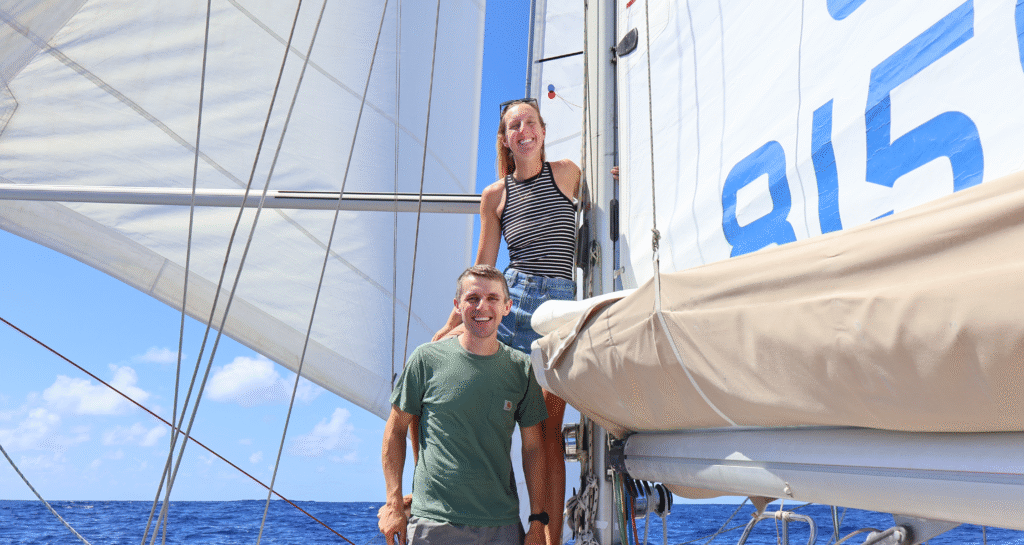
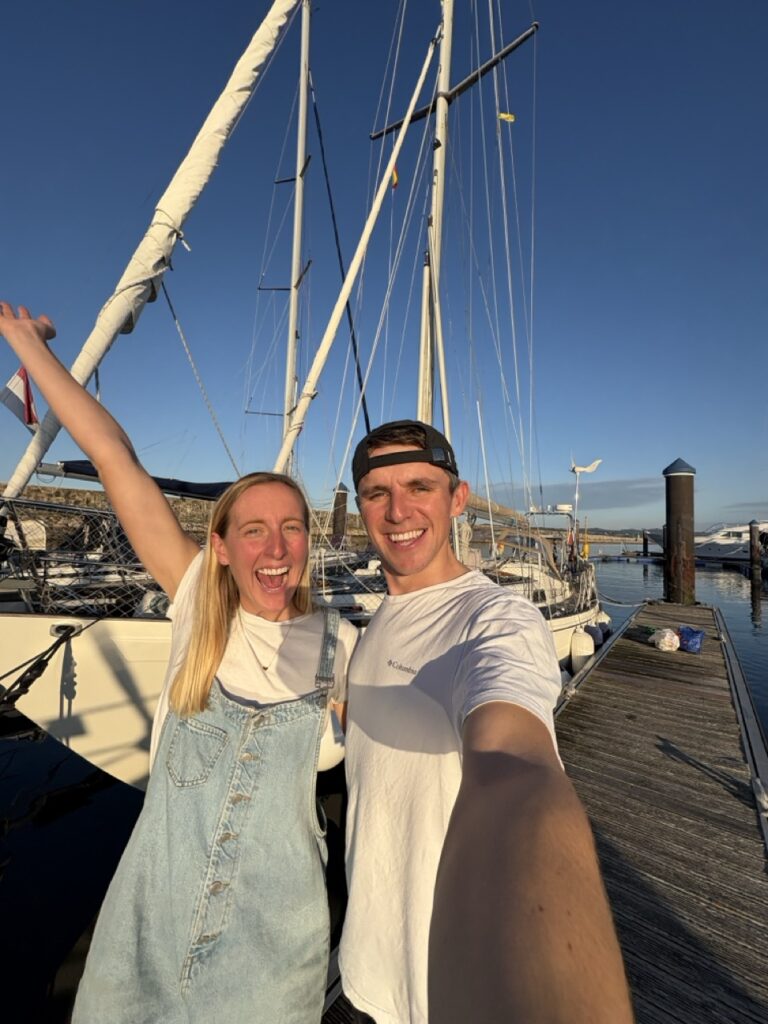
From the very start of our life on board, even before we bought Calidris Alba and had the idea that we might move our lives onboard a sailing boat, we had the rough route in our heads. It was our dream to be able to cruise through the Caribbean Islands, enjoying the stunning scenery, incredible turquoise waters and year-round sunshine. Before getting to enjoy all of that though, we’d have to sail there.
This is the story of how we crossed the Atlantic Ocean, just 7 months after buying our first boat, and only 3 years after setting foot on a sailing boat for the very first time.
Crossing the Atlantic is top of the bucket list for many sailors. Experiencing the thrill of sailing between continents, and the solitude of being out there alone in the deep blue has lured hundreds of sailors over centuries. Whilst being considered one of the more ‘straightforward’ ocean passages, it is a crossing that must be approached with respect and meticulous planning. The consequences of a failure mid-way brings with it a sharp reality that out there, over 1000nm or 10 days from land, you really are on your own.
The Start Line – The Canary Islands
Most boats crossing the Atlantic from East to West, start their journey in the Canary Islands. After leaving mainland Europe, these islands are the perfect place to begin the over 2000nm trip to one of the Caribbean Islands. Popular departure points in the Canaries include Las Palmas Gran Canaria, Lanzarote or Tenerife. All of these places have established infrastructure, supplies and services for the final provisioning and last minute boat preparation before the crossing.
The islands are set up for cruisers setting off across the Atlantic, and can provide anything you could ever need to make the trip a success. Huge supermarkets, chandleries, mechanics and even last minute crew can be found in the Canaries, making it a major hub for offshore sailing.
Not only that but due to the location of these islands, which sit hundreds of miles south of mainland Europe, they are in the perfect location to take advantage of the Atlantic trade winds at this time of year. These winds are a key reason that so many sailors are able to make the crossing each year – more on that to come…
Main Route Options
The Atlantic crossing season starts in late November each year and runs until around March. During that time hundreds of boats take advantage of the more favourable conditions at that time of year to point the bow West and head across to the Caribbean or South America. During this time the prevailing trade winds are generally stable NE to E, between 15kt and 20kt with favourable current, providing sailors with a downwind passage throughout.
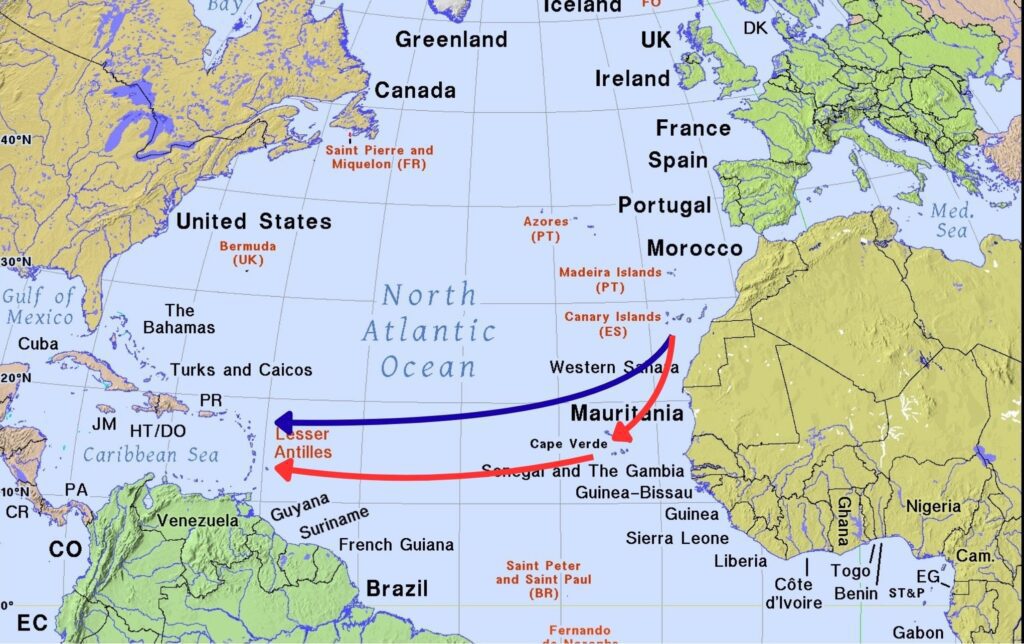
Most boats depart from one of the Canary Islands, which is a perfect launching off point either straight to the Caribbean or via Cape Verde. The Canary Islands sit slightly outside of the trade wind belt, so for many boats the best course for the start of the crossing is further South than the rhumbline. By heading on a course a couple of hundred miles off the Cape Verde islands, this enables sailors to pick up the more consistent trade winds earlier in the passage, and presents the option of being able to divert to Cape Verde in the event of either mechanical failure, to change crew or pick up additional supplies.
Taking the direct route from the Canaries to the Caribbean is a shorter option, being a total of 2700-3000nm depending on where you make landfall, with the detour to Cape Verde adding approximately 600nm to the trip. For a cruising boat like ours, making 5-5.5kts average, this adds up to five days to the overall passage. In our experience the detour was well worth the extra time taken, and allowed the crew to rest, explore a new country and top up on a few supplies before the much longer second leg to the Caribbean.
How long does it take?
Our first part of the Atlantic crossing from Las Palmas to Mindelo, Cape Verde, took 6 days, 8 hours, then from Mindelo to Antigua took 17 days, 1 hour. In total that’s almost 23 and a half days, in which we covered over 2000nm making our average speed over ground just over 5kts.
Being a 41-foot cruising boat we are much slower than longer monohulls and catamarans. Especially on long ocean passages where it’s important to reduce stress on the boat, we were aiming for comfort over speed. Many boats completing the crossing take a similar approach, although some racing and high performance yachts can do it in as little as 10 days…
Knowing roughly how long the passage will take is clearly essential, particularly when it comes to planning the provisioning, watch schedule, and keeping up morale onboard as the miles (and days) tick down. Letting our shore contacts know when to expect our arrival and how much progress we would make is also vital, as they can be an important safety net should things go wrong or you face unforeseen delays.
On the other hand, we found setting clear expectations with any friends and family you have keeping an eye on you remotely is also extremely important to prevent unnecessary worry or concern. We used a Garmin InReach to track and share our position during the crossing, and reminding any friends and family that a small change in course or drop in speed is nothing to worry about, can be vital to prevent undue angst or worry.
Daily Life at Sea
We found having a daily routine whilst on such a long passage was essential for keeping spirits high, and trying to prevent boredom and monotony from setting in. As a crew of 4, we shared cooking and cleaning duties throughout the passage, as well as watch keeping. Due to the two crew we took on in Mindelo not having much sailing experience, we opted for a shift pattern which meant two people were on watch at all times during the night. The pattern went as follows:

This pattern means one pair has a double nightshift every other night, but at slightly more sociable hours than the 0000-0400 hr ‘graveyard shift’. The pattern switches each day due to the two hour slots in the late afternoon, which also coincide with dinner and we used a a time for the crew to all come together and raise any issues or concerns.
This pattern worked for us, as it meant that the two less experienced crew had someone else to consult with, and also meant that when Fran and I were on watch together, we could do sail changes as a two as needed. Any sail changes required whilst Fran and I were getting some rest meant one of us being woken up to supervise.
At the beginning of the trip, Fran and I paired with each of the crew for watches, but after the first few days, once things had settled down and the crew were more familiar with the boat, they were a pair and Fran and I were a pair.
Although we didn’t do solo watches, but as we shared the watch between two, in times of little activity one person could nap in the cockpit whilst being ‘on watch’ but was there available to be woken if needed.
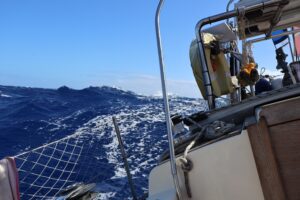
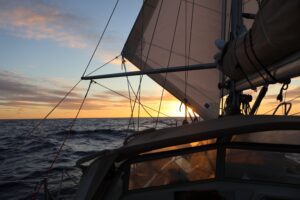
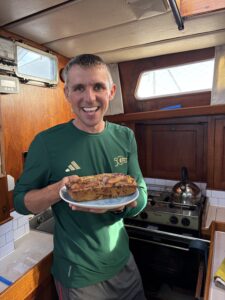
The most important morale booster is always food, and so we made sure to prepare at least one hot meal every day. We had provisioned well in Las Palmas for the entire trip, and only picked up a few fresh items in Cape Verde, where supplies are much more difficult to come by. On days where the swell had picked up, it was an easy tomato pasta dish or something from a tin, but on calmer days we had fresh fish curries, stir fry noodles, even a banana bread for dessert on one occasion.
Daily life is made harder by the continuous rolling of the boat. That takes its toll on the boat itself, but also the crew, with every simple task made much much harder by the constant motion. Keeping yourself balanced becomes natural, but the constant effort to stay upright is draining. Over the 3 week crossing, there is very little opportunity for exercise or physical activity, but just the battle with staying upright is enough to drain your energy levels – at least it helps with falling asleep at night!
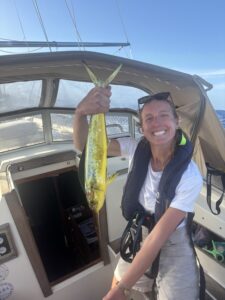
The other activity which helped pass the time was fishing. After trying and failing so far on our trip, we had a surprising amount of success on the crossing, catching 4 mahi and one wahoo. These were all caught during the first half of the trip, because the huge build up of sargasso weed which is covering the Atlantic and Caribbean this season, means that was just about the only thing we caught after halfway. A very frustrating thing, but we were thrilled to have fresh fish on all the other occasions, to the point where we actually stopped fishing as we couldn’t eat it all fast enough or be bothered with the hassle of reeling another one in!
Entertainment on Board
Three weeks is a long time, and staying entertained on board was actually one of the biggest challenges we faced. The constant boredom and feeling of isolation can really start to affect individual morale on board, and once one member of the crew gets down, it’s up to the rest of the crew to boost them back up.
First of all before setting off we’d downloaded plenty of music, podcasts and our favourite TV shows, which always come in handy on those long night shifts when time just doesn’t seem to go by. We’d also stocked up on books (both physical and ebooks), which can be a great way to pass the time, but only when the conditions aren’t too rough or it often makes us feel slightly wobbly!
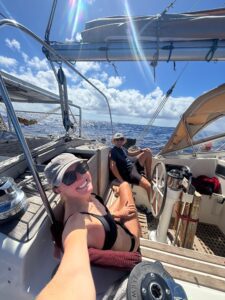
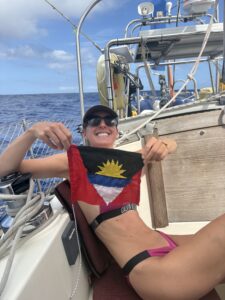
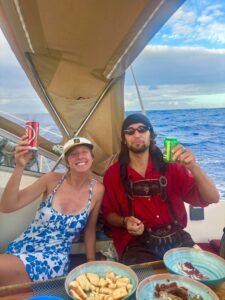
Activities we could do as a whole crew were by far the most enjoyable though. Playing games, chatting and listening to music brings the whole crew together. We were fortunate that our crew were also brilliant guitarists and both brought a guitar onboard with the to ‘work on an album. This meant we were treated to background music throughout the crossing (we enjoyed it, honestly!), as well as regular group karaoke. Sometimes even making use of our fog horn/loud hailer for amplification – thankfully out in the middle of the Atlantic Ocean there was definitely no one that could hear us!
The Weather
Our crossing ended up being slightly late in the season, mostly because we only left the UK in October, so had to make our way down the coast of Spain and Portugal before even making it to the start line in the Canaries. This meant the Atlantic trade winds were settled in for the season, and by and large we were very fortunate with the weather we had on the crossing. Aside from a few days of very light winds towards the end of the crossing, the winds were consistently 15-20kts, between ENE and ESE. The swell for most of the time was a fairly choppy 2-2.5m with 8-10s periods, but we also experienced big 4m+ swell with very long 16s period, which turned out to be surprisingly comfortable, along with a day or two of very calm seas.
One of the main surprises was the lack of squalls. We had read and been told by many experienced cruisers, to expect very short sharp squalls, often at night. These come with a dramatic increase in wind speed, and often change in direction as well as heavy downpours. Throughout the whole trip we didn’t experience a single squall, something we feel very fortunate about. A couple of times we had sharp bursts of rain, but accompanied with only a small increase in wind speed, certainly nothing like the conditions we’d been warned about.
Having since spoken to lots of other cruisers who crossed the Atlantic at various times throughout the previous season, it seems we were extraordinarily lucky. By no means does this suggest that anyone planning a crossing should dismiss the risks posed by squalls, we were ready to act should one have hit us – it just seems we were very lucky this time…
The Atlantic crossing was easily the biggest part of our journey sailing from the UK to the Caribbean, if you would like to find out more about our adventure, check out the full round up: From the UK to the Caribbean: Our First 6,000 Miles Sailing Calidris Alba
Common Problems During the Crossing
On our crossing we were extremely fortunate that nothing major broke, and we had very few problems arise. The main problems we faced were failure of the gas system used for cooking, compounded by the gas locker at the stern filling up with water. Whilst underway we had diagnosed the issue as a gas leak, which turned out not to be the case, but at the time out of an abundance of caution we shut down the gas, and continued for the rest of the passage on an electric stove we could power with our onboard generator, and the electric kettle which we ran off the Jackery powerbank.
Losing our gas stove was an issue, it meant no more oven dishes and cooking off the electric hob and the generator was more difficult, but thankfully we had these backups in place so all was fine in the end. Without these redundancies it would have been cold tinned food for weeks!
Other common problems on long ocean crossings are mostly related to chafe, wear and strain on the boat, which comes with the continuous sailing over such a long period of time. To mitigate some of these issues, every day or so we went round to check the rig for any signs of wear, move the position of the sheets on the genoa and jib, as well as whisker poles to prevent chafe, and kept an eye on other areas of the boat where the constant motion can easily rub straight through lines. These checks seemed to work for us, and although many of the lines showed significant signs of wear come the end of the crossing, nothing close to failure.
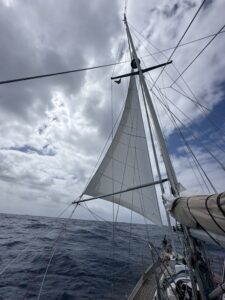
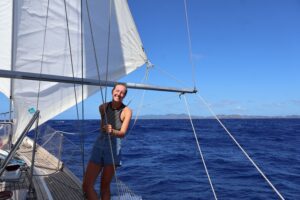
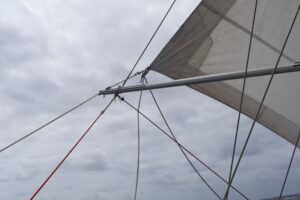
This issue may also be helped in our case, by the sail configuration we chose. On Calidris Alba we don’t have a spinnaker, gennaker or a cruising chute, only ‘white sails’. Being a cutter rig, we have the benefit of two headsails and two whisker poles, so for 90% of the crossing, had both the genoa and inner staysail poled out on each side in a ‘butterfly’ formation. Many of the more serious failures due to chafe are when flying a spinnaker, a common failure point being at the halyard. Due to our sail setup, and the fact that both headsails have the furler and forestays to support them, we were thankful not to be too concerned with this failure scenario.
Our sail setup for the crossing worked brilliantly for us, and is something we’ll cover in a future blog in more detail…
Arrival in the Caribbean: First Landfall Feeling
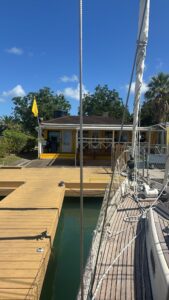
We made landfall in Jolly Harbour, Antigua on Friday 13th February at 13:00 (spooky right?!). Exhausted, relieved and proud of our achievement. We’d done it, we’d crossed an ocean! Our first glimpse of land came overnight, where the glow of the lights from Antigua and the neighbouring island Guadeloupe came into view on the horizon. Then at first light came our first sight of Antigua. Known for being a fairly low-lying island and therefore difficult to distinguish from out at sea, it wasn’t long before we were making our approach to the West side of the island where Jolly Harbour is situated.
Once we’d carefully navigated our way through our first ever shallow reef, the colours, sights and sounds of the Caribbean hit us straight away. The unmistakable smell of civilisation, a welcome awakening of the senses after such a long time in the ‘desert’ of the ocean. Turquoise waters like we’d never seen before, right in front of us. We’ll never forget the first time sailing our own boat through crystal clear waters, with a turtle for company to welcome us into port.
The arrival in Antigua meant going through the customs and immigration formalities at the office in Jolly Harbour, something we’d been warned to be prepared for, and prepared we were. All our documents nicely kept in a folder and the online ‘Sailclear’ declaration completed in advance, we were in and out of the offices very smoothly.
Then off to top up with fuel to refill the amount we’d used on the generator and approx. 36 hours of motoring that we’d done, most of which was to get us through a light wind patch in the final few days to make sure we arrived before the weekend! After fuel, we thankfully pulled into the marina with the help of the friendly dockmasters without trouble. Treating ourselves to a few nights in the marina to relax and sort out the boat, after 17 days of continuous sailing felt like bliss.
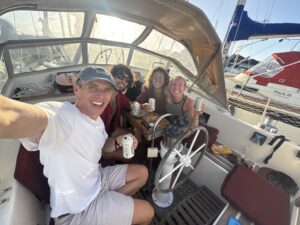
Celebrating with beers in the cockpit, that we’d been saving for this very moment, meant only one thing – Calidris Alba and her crew of four had crossed an ocean and made it to the Caribbean.
What’s Next for Calidris Crew
Although the Atlantic crossing was such a huge part of our journey so far, it’s very much just the start of our Caribbean adventures. After some time recovering, the cruising starts now, and we can’t wait to explore everything the Caribbean islands have to offer. With so many different islands, cultures and new places to explore we’re so excited to get out there. More on that to come…
You can follow our journey in real time on Instagram @calidris.crew.