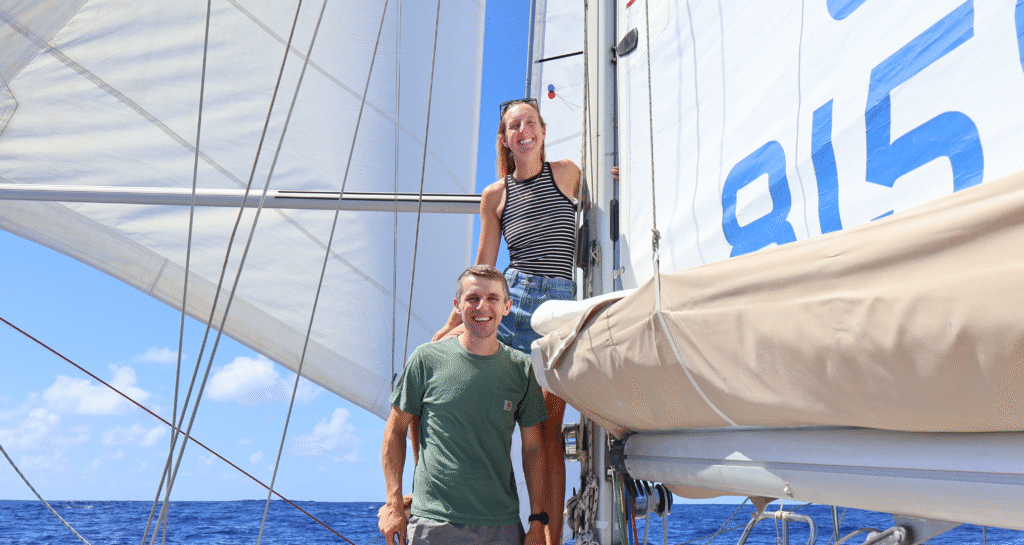
At the start of 2026, we took our 40 year old sailing boat ‘Calidris Alba’ across the Atlantic. The 2100+ mile crossing from Cape Verde to Antigua took 17 days, and was the biggest adventure we have ever been on. Being so far from land means you’re very much on your own out there, and need to be able to deal with anything the seas throw at you. In this article, I’ll take you through some of the things we did and equipment we bought to prepare for a safe Atlantic Crossing.
Note: This post contains affiliate links. If you make a purchase through these links, I may earn a small commission at no extra cost to you.
Being at sea for almost 3 weeks, completely separated from the outside world, means no matter what happens, you need to be able to handle it. With the consequences of any incident hugely magnified by the remoteness and isolation of being literally weeks from outside support, when it comes to safety when sailing offshore, there is no room for complacency.
Preparing for first Atlantic crossing
Crossing the Atlantic Ocean isn’t something we did on a whim. After leaving the UK in October 2025, we had already spent the best part of 3 months preparing for the Atlantic crossing. Then along the way from the UK, down the coast of Spain and Portugal, and across to the Canary Islands, we continuously made improvements to the way our boat was set up for crossing oceans.
Then in January 2026, we prepped the provisioning to make sure we had enough food and water onboard, we checked the sails, scrubbed the hull and washed the decks, but when it comes to safety, we made it the top priority.
Here is a list of just some of the things we did and safety equipment we have onboard our 41-foot sailing boat, so that we know we’ve done everything we can to make her safe to cross oceans.
EPIRB
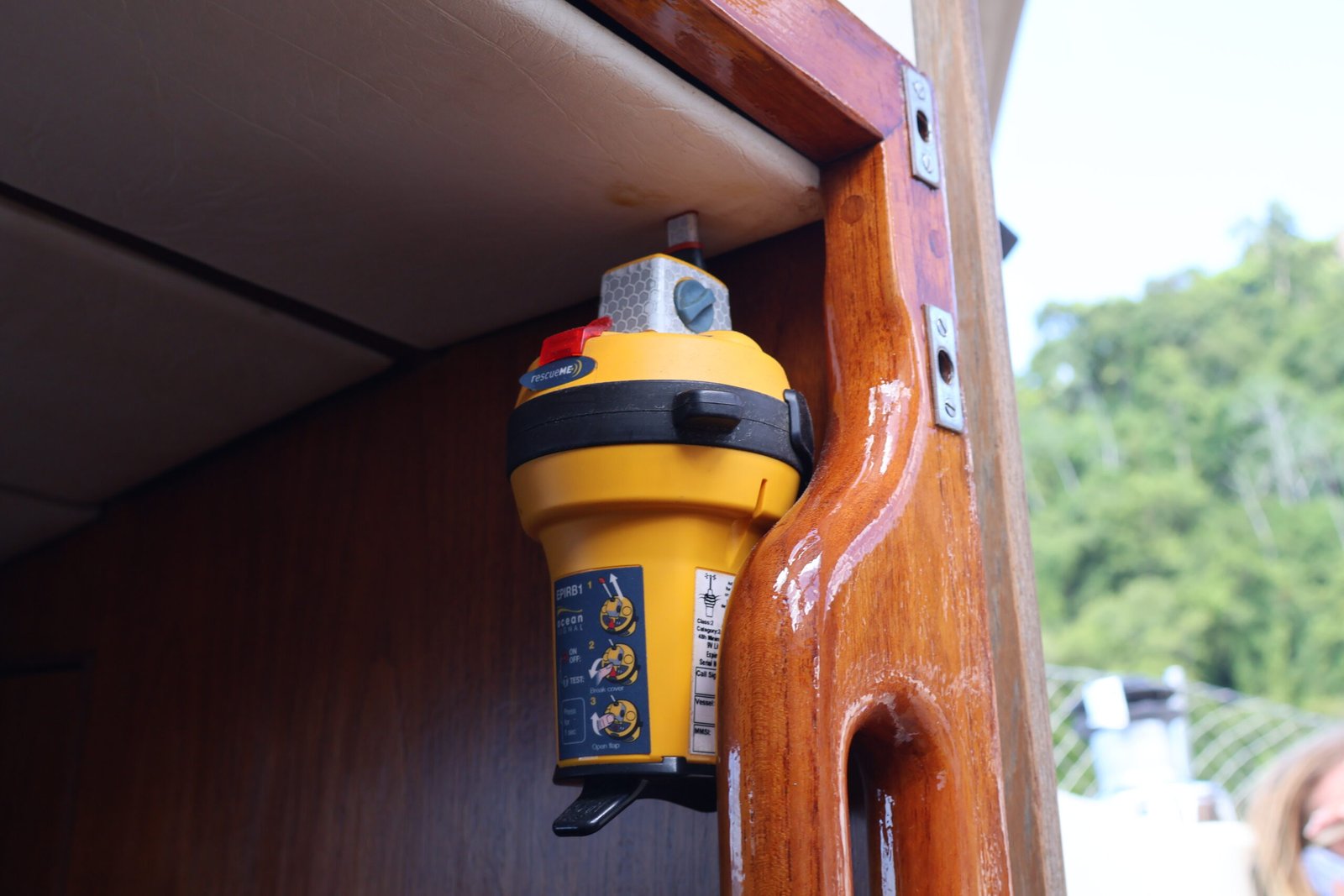
An EPIRB (Emergency Position Indicating Radio Beacon) is a piece of equipment we hope to never need to use. This beacon is used to transmit your position in an emergency to search and rescue rescue services, wherever you are in the world, including the middle of the Atlantic Ocean.
The device transmits its GPS position as a distress signal on 406MHz frequency, which is detected by a satellite system and relays the alert to a Rescue Coordination Centre (RCC). This centre then coordinates a Search and Rescue team or is able to alert nearby vessels.
Activating an EPIRB is only something you should do only if you find yourself in grave and imminent danger, where loss of life is possible, and therefore is at the very top of the list when it comes to considering the different severity of scenarios we could have onboard.
LIFEJACKETS AND TETHERS
One of the first things we bought straight after buying our boat, was well fitting lifejackets. There were plenty of lifejackets onboard that were left to us by the previous owners, but we wanted to make sure the ones we bought fitted properly, were comfortable to wear for long periods of time, and had been properly serviced and looked after.
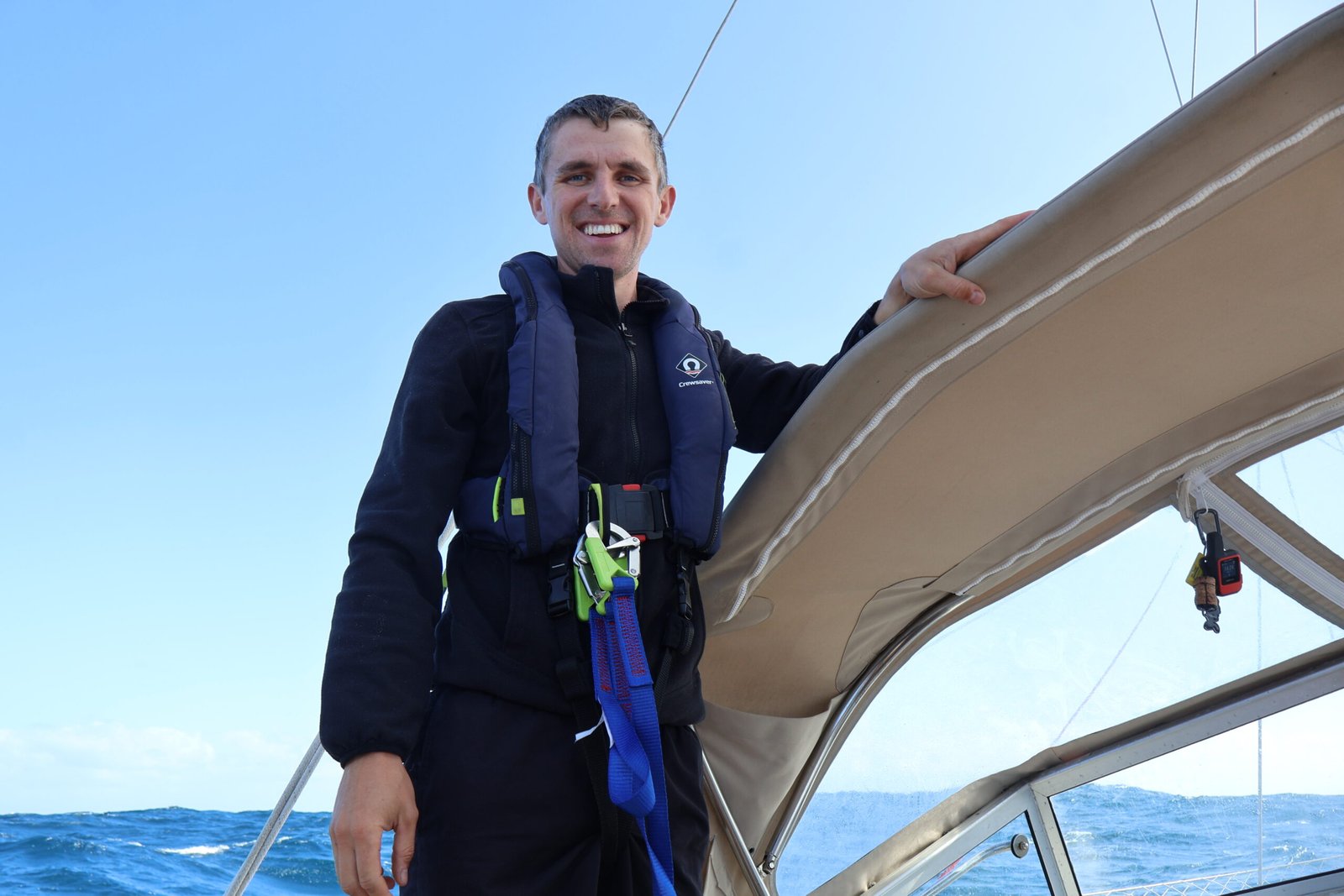
Fran and I both chose Crewsavers Ergofit 190N Automatic jackets, which have loads of great features for offshore sailing, whilst not being too bulky. We had tried these lifejackets on a training boat before buying them, and I’d really recommend trying on different brands before buying your own to see what works for you.
As well as lifejackets, we also bought new tethers, which we use to clip on to a hard point inside the cockpit or onto the jack lines which run the length of the boat. This means we are physically connected to the boat, and stops us from falling overboard should we lose balance or hit a big wave unexpectedly whilst moving around the boat.
On our boat all lines for the main sail are controlled from the mast, so these tethers are particularly important if we need to reef or change the sails, as we can move up to the mast whilst still being clipped on.
FLARES
Something else we needed to upgrade before going out sailing were our flares. Although we also had some onboard the boat from previous owners, they were close to expiry and we wanted peace of mind that they had been properly looked after, rather than being left in a wet locker for years!
Pyrotechnic flares are still the industry standard for sailing vessels, and we chose a mixture of red hand flares, orange smoke flares and parachute rocket flares. This meant we were covered in different scenarios where each of different type of flare works best, and had a stock that should last long enough to alert and then direct search and rescue services to our location in an emergency.
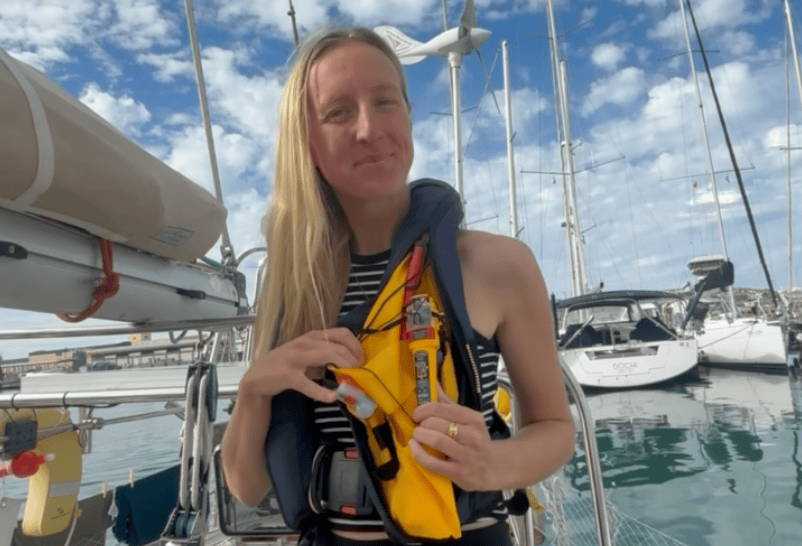
MAN OVERBOARD DEVICE (Ocean Signal rescueME MOB2)
Prior to our first offshore passage across the Bay of Biscay, we were going through our procedures for a man overboard, particularly at night where one of us is on watch and another is down below getting some rest. This led us towards a Man Overboard Beacon, which fits inside a lifejacket, and emits an instant AIS & DSC Alert should it end up in the water. These alerts are picked up by nearby vessels, including ours, and set off a loud alarm onboard as well as emitting the position of the MOB to aid the recovery.
One of our worst fears is coming up in the night to change shifts, and the person on watch no longer being in the cockpit after falling overboard. The main way we prevent this is by always being clipped in with tethers during the night, but by also having MOB devices it gives us reassurance that should this happen we have another safety measure in place. We chose rescueME MOB2 from Ocean Signal, and have one fitted in each of our lifejackets.
This product was gifted to us by Ocean Signal, but all thoughts and opinions are my own. If you make a purchase through one of these affiliate links, I may earn a small commission at no extra cost to you.
Check out the range of Man Overboard Devices from Ocean Signal and use our code ‘calidriscrew12’ for 12% off here: 12% off Ocean Signal with code ‘calidriscrew12’
LIFERAFT
The old saying goes, that you should only ever step ‘up’ into your liferaft, and so this item also only falls into the category of something we hope to never need to use. The liferaft we have onboard is an Ocean Safety 6 person liferaft, which we had serviced by the manufacturer before setting off from the UK.
Before setting off on any offshore passages, we also completed our RYA Sea Survival course, where you get the chance to experience what it’s like to get into a liferaft, recover people from the water and wear an inflated lifejacket. The main lesson we learnt from the course is that liferafts are a miserable place to be, and even in a 25m swimming pool, the feeling of nausea and being claustrophobic sets in pretty quickly. It’s good to know we have the liferaft ready on deck should we need it, because it could save our life one day, but we’ll be doing everything to make sure we never need it.
GARMIN INREACH SATELLITE PHONE
Our Garmin inReach is as much of a safety device, as well as a means of contacting our friends and family whilst we’re out on long ocean crossings. For a monthly subscription, we are able to share our location in real time, as well as send short SMS messages – something which was really nice during the Atlantic crossing where we had turned off our Stalink and other forms of communication were out of range. A short check in message can go a long way to boost morale onboard as well as keeping contact friends and family watching back home.
The satellite phone has the other benefit of also being able to alert search and rescue services in the event of an emergency, something we could use alongside our EPIRB. Having two methods of contact can be a good way to make clear to the emergency services that this is a genuine incident, rather than just an accidental activation.
Conclusion
Onboard we tried to follow an approach that Jack used to use whilst working as a Safety Engineer before we set off on our trip, something known as the hierarchy of risk control. This follows the concepts of either elimination, substitution, controls or protection, when looking at managing risks. In order of effectiveness, the best way to remove the risk is to eliminate it entirely, and by making plenty of changes on board we have managed to do that in many cases. It’s better to eliminate the risk entirely, than just wearing protective clothing in a dangerous situation!
Yet sailing offshore brings plenty of risks, and having back ups, redundancies and contingency plans in place provides reassurance, and an additional layer of protection should an incident happen at sea.
These are just some of the items we have onboard, it’s by no means an exhaustive list and we’re learning as we go, so are definitely not experts when it comes to ocean crossings. This is just what we considered to be some of the essentials, and attitude to risk is very much a personal decision, so do your own research before heading out there yourself. Get in touch if there are any other specific pieces of safety equipment you would take on an Atlantic crossing, we’d love to hear from you!
To read more about our Atlantic crossing aboard Calidris Alba, check out the full round up: Our Atlantic Crossing: Canary Islands to the Caribbean. To follow our journey in real time, check us out over on Instagram @calidris.crew.
About the Author