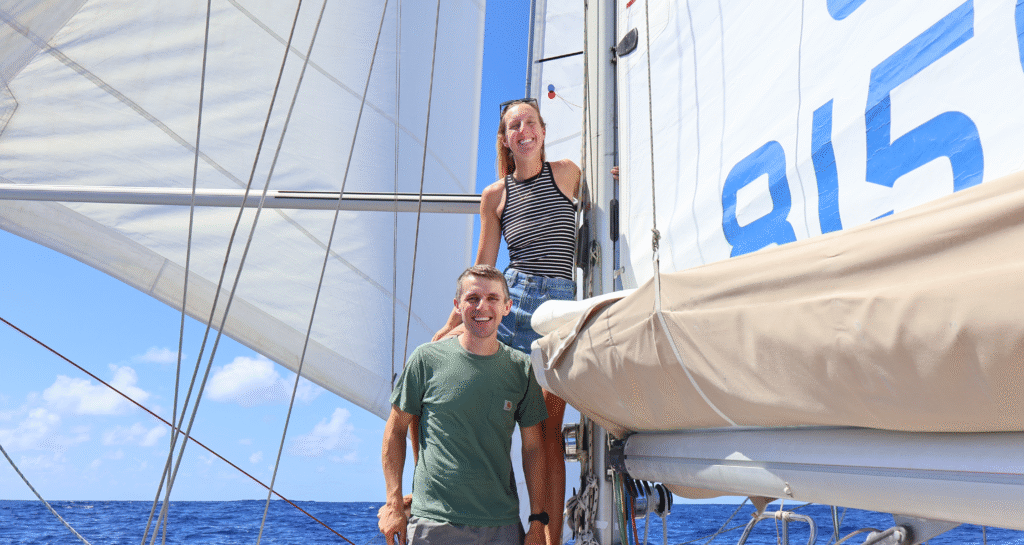
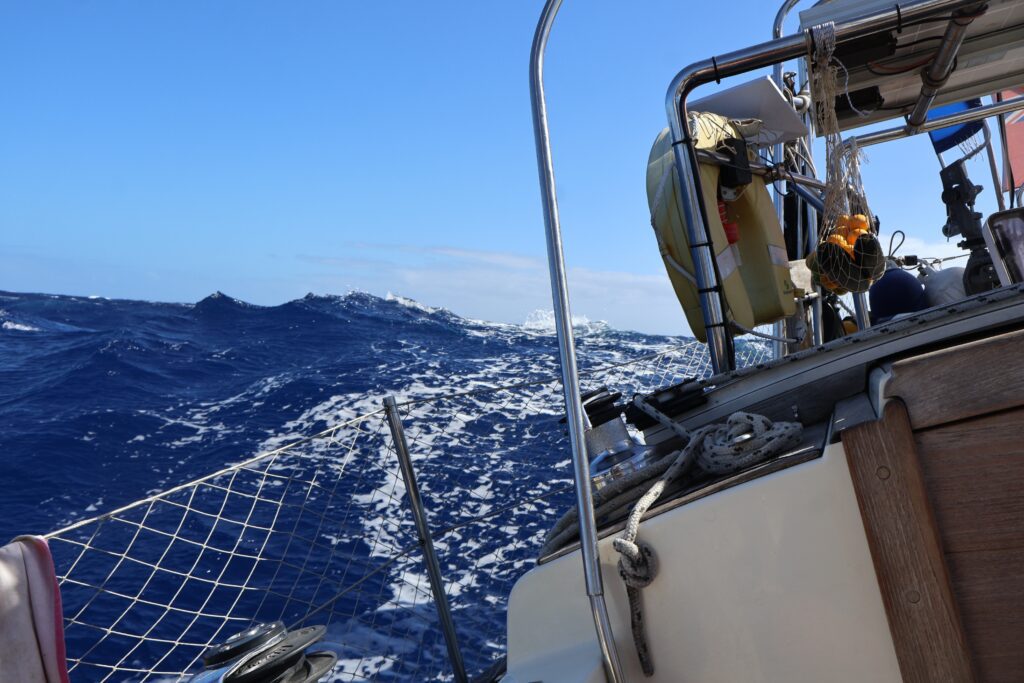
Crossing the Bay of Biscay is high on any sailor’s bucket list. It’s one of the big ones. A notorious reputation for huge seas, strong winds, and forecasts that don’t always tell the whole story, makes this crossing one that many sailors fear. For us, it was the first time we’d be truly detached from the safety net of land.
In this article
Leaving from the south coast of the UK and heading to Europe leaves no choice but to cross the Bay of Biscay, or face a lengthy detour. So, with our dream of exploring Europe and the Caribbean on our sailing boat Calidris Alba, we had to tackle this daunting passage head-on. We knew it would take meticulous planning and preparation to get ourselves and our boat ready for the 400-nautical-mile crossing. Even then, the open ocean can be extremely unpredictable and will always spring a few surprises along the way.
This is the story of how we took our 40-year-old sailing boat and, in just three months, got her ready to set off across the Bay of Biscay.
Routing
The Bay of Biscay covers the area of sea off the West coast of France, and the Northern coast of Spain, up to the English Channel. A huge expanse of water, well known for its size but also its variable depth. The huge continental shelf cuts across the Bay to the North and South, creating rapidly changing depths from 200m to 4000m, which often creates huge swell and confused seas.
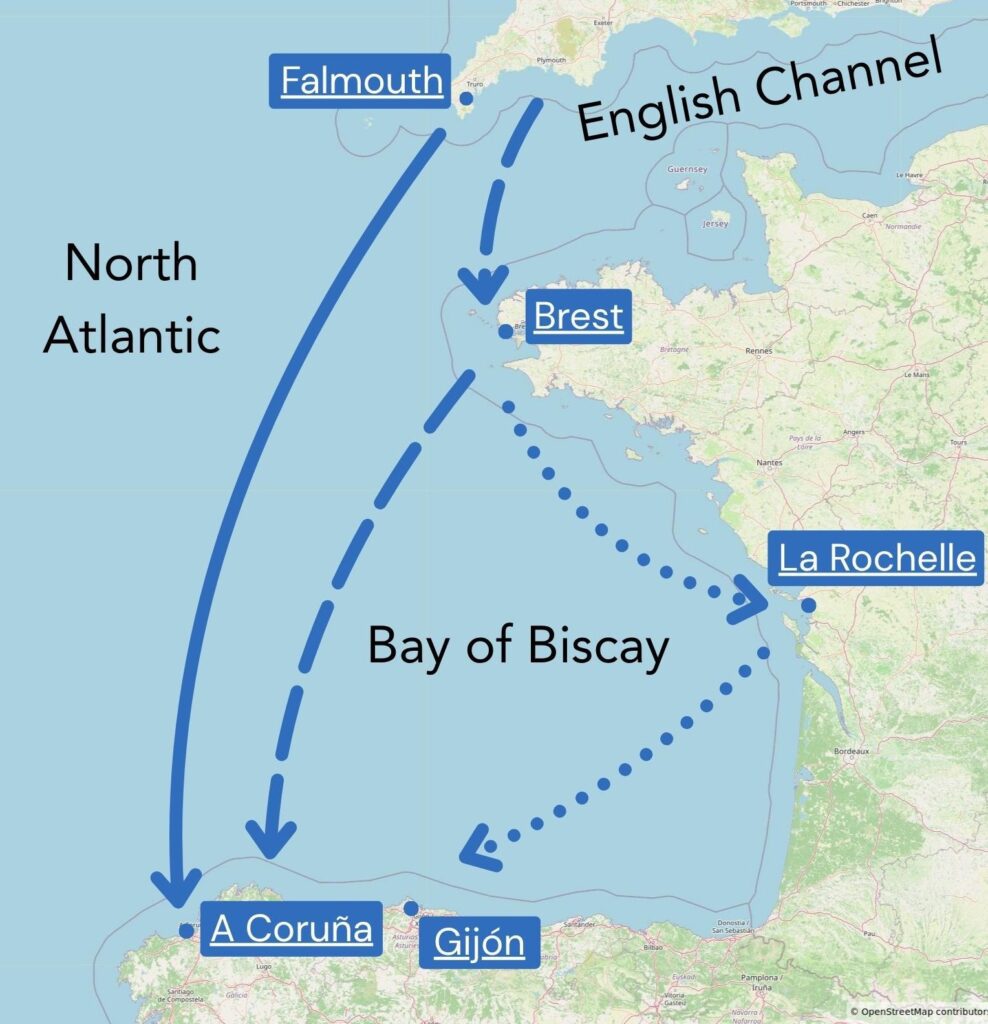
There are a few options when it comes to planning a Bay of Biscay crossing from the UK to mainland Europe.
- Depart the UK from Falmouth and head straight across to Northern Spain, making landfall in A Coruña, Gijón or with favourable wind direction, Finisterre.
- Leave the UK from the South coast, between Plymouth and Southampton, and cross the English Channel to the Brittany coast. Then set off from Brest for A Coruña or Gijón.
- Cross the English Channel to Brest then down the West of Coast of France until La Rochelle, and cross to Northern Spain
We bought our boat Calidris Alba in Chichester Harbour on the south coast of the UK, and then spent the summer cruising towards Falmouth in Cornwall. By the time we’d enjoyed the UK summer, and got the boat (and ourselves!) ready, it was the end of September 2025. Faced with multiple Atlantic storms during September and the start of October, most notably ‘Storm Amy’, we were left with little time to cross Biscay in the 2025 season.
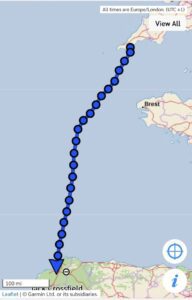
That meant, with limited time to spare, we chose the first option, straight from Falmouth to A Coruña. This gave us the most direct route to Northern Spain, leaving approximately 430nm ahead of us. Unfortunately our chance to explore the French Brittany coast and the exciting sailing it provides, would have to wait.
This route also has the added benefit that we would save some of our 90 EU ‘Schengen’ days, by only checking in to mainland Europe when we made landfall in Spain, rather than Northern France.
On the basis of an average speed over ground of 4.5-5.5kts means up to 4 days of sailing direct from Falmouth to A Coruña, making it a much longer trip than we’d ever done before. Before setting off we knew that we possibly had the option of being able to divert to Brest in an emergency, but even then only in favourable winds. After that we were on our own.
Weather Windows
Most modern weather forecast models are considered reliable for up to 3 days out. For a 4 day passage, this means there is a fair amount of uncertainty when it comes to choosing the right weather window to cross. We studied the weather models ahead of our trip, and luckily were presented with an opportunity to leave on 10th October 2025. The forecast was for favourable winds from the East, between 12-16kts and moderate seas.
When checking the weather we kept a close eye on not only the forecast for the Bay itself, but also at a wider level for any low pressure systems building in the North Atlantic, which would affect the 3-6 day outlook. Thankfully the models all agreed and we had the confidence in the forecasts to go for it.
When planning any longer passage we always turn to windy.com for the latest up to date wind and swell forecast. It’s really easy to compare each of the weather models (ECMWF, GFS, UKMO etc) and the route planning tool makes it so simple to see the forecast for your projected location over the full length of the trip.
Preparation
The preparation for our Biscay crossing in many ways began right back in the boatyard, just after we bought Calidris Alba in May 2025. We spent weeks getting her ready to cross oceans again, focused on making sure that she was up to the challenge of offshore sailing. This primarily meant looking through all safety equipment, replacing anything that was expired or outdated, and building our confidence and knowledge of the onboard systems.
Once we had built up the basics, our time living on board full time let us focus on getting used to how things worked. Preparing meals in small spaces, sleeping whilst underway and understanding how she sails in different conditions were all important parts of our preparations for heading offshore.
In the weeks before we set off across the Bay of Biscay, these are just some of the things we prepared to make sure the crossing went smoothly:
- Provisioning: Prepared 3 days worth of meals that only need to be heated up whilst underway to provide a hearty and nutritious meal. Also made sure we had plenty of snacks to keep us going through the night shifts!
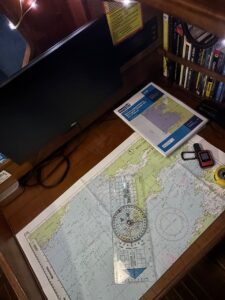
- Passage Planning: Using both Navionics and our paper chart, we planned our route to take into account the shipping lanes and traffic separation scheme (TSS) in the English Channel. For our arrival, we prepared our detailed pilotage plan for arriving in A Coruña as well as making sure we had the information we needed to divert to Brest if required. We also plotted our waypoints on the chart plotter in the cockpit for every 12 hour interval to keep us on the correct course.
- Running Repairs: We had a few final items on our to do list in the way of repairs. Our wind transducer had decided to stop working in the week before our crossing (perhaps caused by strong winds in Storm Amy!). Thankfully we were able to get hold of a replacement so I headed off up the mast to fit the new unit. We also took advantage of the great chandleries in Falmouth, and bought a few final things on our shopping list.
- Safety Checks: Double checking all our safety equipment was vital before such a long offshore passage. We checked our personal locator beacons, switched on our Garmin InReach tracking satellite phone, put our lifelines in the cockpit ready to clip in, double checked our grab bag and emergency procedures, and let our shore contacts know our plans should the worst happen.
See how we prepared for our crossing by checking out our video over on Youtube:
The Passage
Passage Stats
- Distance Travelled: 430nm
- Total Trip Duration: 3 days, 6 hours, 20 minutes
- Average Speed: 5.5kts
- Maximum Wind Speed: 20kts
- Most miles in 24 hour period: 148.8nm
- TIme Motoring: 9 hours
At 8:10am on Friday 10th October we slipped lines at Falmouth Haven marina and set our course for A Coruña. We’d done the preparation and we were itching to get going.
Thankfully the weather forecast was correct, and we eased into the first day with light winds and motored for the first five hours, then set up the windvane self steering to settle into the passage. We’d also timed our departure with the tidal streams running West for the first 6 hours, making our departure from UK waters as smooth as possible.
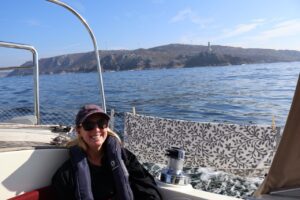
On a comfortable beam reach with following seas, Calidris Alba was in her element. Comfortably sitting at 6-7kts, we were making much better speed than even our most conservative speed prediction. She was sitting nicely in the water and the swell felt manageable, even as we crossed the continental shelf into the much deeper waters. Our Hydravane was also being put through it’s paces for the first time since we’ve owned Calidris Alba. We’d practiced setting our course with the wind self-steering, but never had it steering our course over longer periods before, or in slightly bigger seas and stronger winds. With the huge benefit of preserving power by not needing to run our electric autopilot, the Hydravane was holding our course beautifully.
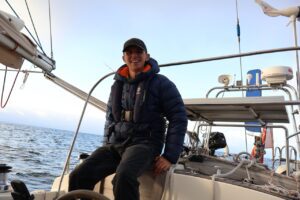
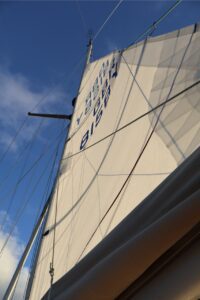
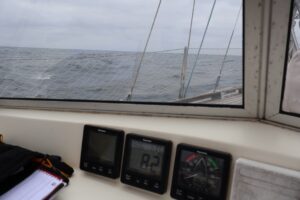
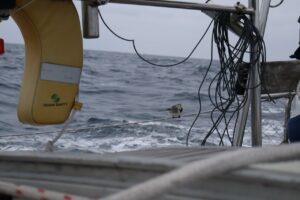
A small panic on day two when our AIS (Automatic Identification System) appeared to stop working, we think due to us not having the ‘Europe’ card for our chart plotter installed. This system shows nearby vessels on our chart plotter (as long as they have the equipment fitted) and means we show up on their system which is very reassuring around the huge cargo ships. Despite being certain I checked before we left, there are always things which come to surprise you. Thankfully the issue was quickly resolved when we discovered that we actually had an old card from 2013 onboard (thanks to one of the previous owners for that!).
We also managed to tear off our clew slider where the mainsail attaches to the boom. Luckily the outhaul was still attached to the sail and before long we’d lashed it together to last us until we could make a more permanent repair in A Coruña. Other than a couple of these small issues we managed to last the passage without any more serious breakages!
Struggling on Nightwatch
Our night watches were by far the biggest struggle of the crossing. We decided to cross just the two of us rather than taking on any additional crew so that we could get used to sailing longer distances as a couple. Being slightly late in the season meant that the nights started early and were very cold, and despite putting on our warmest coats, jumpers, hats and gloves, could not stay warm during the 2 hour shifts.
We chose two hour rotations for our night watches, mainly due to the cold and even with a hot water bottle in our laps we were struggling to last the duration. With only two of us onboard you become ‘ships in the night’ only seeing each other at shift handover, and struggling with boredom no matter how many podcasts and Spotify playlists we’d downloaded.
Most of the activity during the night was keeping a lookout for the significant shipping traffic out in the Bay. Over the 4 day passage we crossed the ‘Off Ushant’ Traffic Separation Scheme in the English Channel, as well as the busy shipping lane between there and North Western Spain. We noticed that many of the ships slightly altered their course around us, as soon as our CPA (Closest Point of Approach) got close to two miles on AIS. Whilst reassuring to know they were keeping watch in the bridge, we still kept a sharp lookout to prevent any close calls.
Land Ahoy
We passed the time with plenty of card games and enjoyed the feeling of solitude, peace and quiet that comes with longer offshore passages. At the first sight of land, a huge sense of accomplishment and relief met our slightly heightened anxiety as we were now much closer to ‘Orca territory’…
Once we’d hoisted our Q flag and contacted the marina on the VHF, we pulled into our berth, feeling ready to put our feet up, soak in our achievement and enjoy exploring a new city. A new city that had taken us over 3 days to travel to on our very own floating home.
See the passage in full on our Youtube channel:
Lessons from our first offshore passage
Whether it was all the preparation we put into our first offshore passage, or sheer good fortune (probably a bit of both!), we couldn’t have asked for a much more successful introduction into the world of offshore sailing. Our preparation had begun from the day we bought Calidris Alba, and arriving in A Coruña felt like the reward for all of our hard work up to that point. Despite the success of our first offshore passage, we learnt a huge amount about ourselves and our boat over the 3 and a half days at sea.
LESSONS LEARNED AND TOP TIPS
- 2 hour watch pattern: We followed a two hour rotating watch pattern for each night shift, between 8pm and 8am the following morning. This pattern meant that whilst it was easier to stay awake for the two hours you were on watch, it was very difficult to get a good rest when off-watch. For future passages we will definitely increase the length of each watch to 3 or even 4 hours if possible.
- Food preparation: Having meals prepared before the passage that we could store in the fridge and reheat was an absolute necessity. Even in the moderate seas that we had throughout the passage, not having to spend too long down in the galley preparing meals made things much more manageable. Having hot meals each night also really boosted morale and kept us both well fed and in high spirits.
- Fully prepare a passage plan: Most of the sailing we had done before setting out across the Bay of Biscay was within sight of land, which makes the navigation much more straight forward. Always having a reference point to estimate your current position and rough direction of travel means you don’t need to rely on a chart or calculate a course to steer to end up at your destination. It may sound obvious, but once offshore, without those reference points it can be easy to become disorientated or lose track of your course. We had our whole passage roughly planned out before departure, so we knew our course to steer for the whole passage, which took into account crossing the various shipping lanes, as well as tides and currents as we were leaving Falmouth. Of course there are electronic tools and equipment which now make this much more straightforward in real time, but as we experienced on the passage, things can stop working so it’s so important to have a back up.
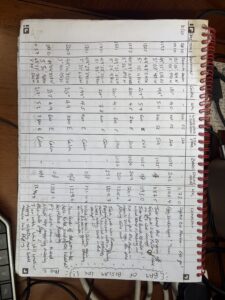
- Keep a running log: Since owning Calidris Alba we have tried as much as possible to keep a written log of our trips. On longer passages we’ve found this to be even more valuable, to keep a track of position, speed, wind direction, air pressure and engine hours, amongst other things. This is a great way to spot if there is any drastic changes in the weather, or boat speed for example, which might be a sign we need to reef. It’s also a really easy way to keep some routine to the day and in many way help pass the time, with the log entry being a very small milestone to look forward to each time we change over the watch.
The Calidris Crew
Thanks for reading this blog article on our Bay of Biscay crossing. If you are planning the passage in the future, hopefully it’s provided some useful insights and helped you prepare for a successful passage.
The crossing was the first big leap in our journey sailing from the UK to the Caribbean, if you would like to find out more about our adventure, check out the full round up: From the UK to the Caribbean: Our First 6,000 Miles Sailing Calidris Alba